Breakthrough innovation has a distinct character compared to the slow, steady, and predictable advances that typically define business improvement. Incremental change optimizes; breakthrough change redefines. The former keeps companies competitive in the short term, while the latter shapes entire industries over decades. Understanding when incrementalism has reached its limit — and when a leap is required — is a crucial strategic skill for leaders navigating uncertain futures.
When Incrementalism Peaks
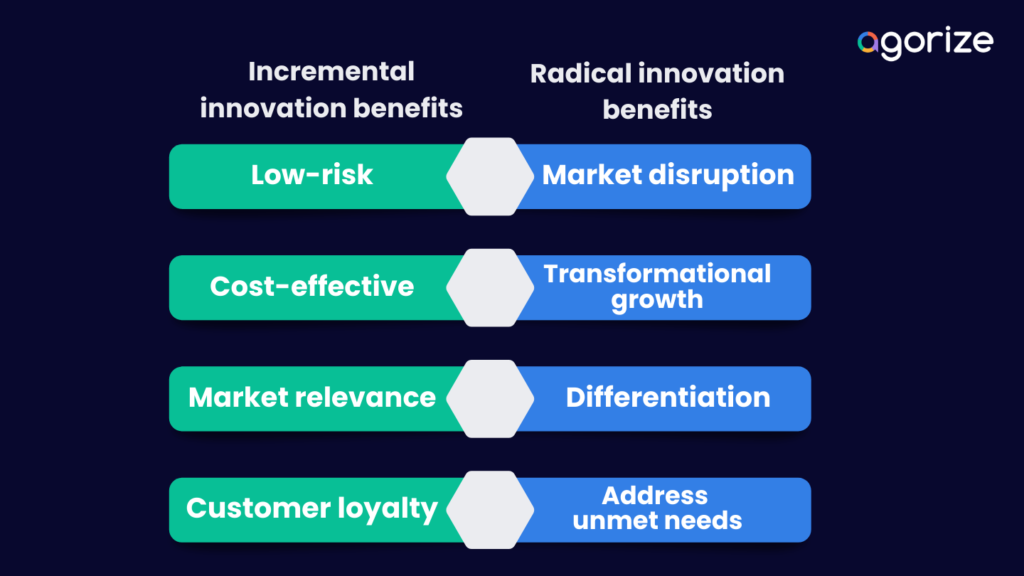
Incremental improvements are often the backbone of continuous performance optimization. They reduce defects, lower costs, and improve user experience by degrees. This approach works well in stable environments where the rules of competition are clear and customer expectations evolve gradually.
But in markets shaped by rapid technological shifts, regulatory changes, and collapsing cost curves, incrementalism has a natural ceiling. A firm can only optimize so much before additional efficiency gains become marginal.
Signals That You Need a Leap
Several indicators suggest it’s time to shift from incremental to breakthrough innovation. These include:
- Diminishing Marginal Returns — Optimizing further brings little improvement relative to effort.
- Disruption at the Edges — New entrants begin offering alternatives that redefine value.
- Demand Outpaces Capability — Customers’ needs evolve faster than existing processes can adapt.
- Structural Constraint — Existing business models can’t support new opportunities without fundamental redesign.
Leaders who ignore these signals often find themselves outpaced not by faster incumbents, but by outsiders who redefine the category entirely.
Breakthrough Innovation Requires New Rules
Breakthrough change rarely emerges from the same structures that support incremental improvement. While incrementalism prefers control, stable processes, measurable ROI, and consistent feedback loops, breakthrough innovation thrives in ambiguity. It requires experimental thinking, risk tolerance, and alternative business models.
The psychological component is also crucial. Incremental teams look for confirmation; breakthrough teams look for possibility. Incremental work is about refining the known; breakthrough work is about exploring the unknown.
The Keyword Paragraph (Single Mention)
Some industries attempt to systematize breakthrough development by adopting frameworks like innovation strategy consulting, which help organizations examine future market developments, customer value creation, and competitive dynamics through structured exploration rather than reactive optimization.
Breakthrough Innovation and the “Zero to One” Effect
While incremental progress makes systems better, breakthrough innovation makes old systems obsolete. Peter Thiel’s famous “zero to one” framing captures this: moving from nothing to something fundamentally new generates disproportionate value relative to moving from something to something slightly improved.
Industries that have undergone major breakthroughs — energy, mobility, cloud computing, entertainment, fintech, and biotech — did not merely improve on existing paradigms; they replaced them. Streaming didn’t optimize DVDs; it replaced them. The smartphone didn’t refine the flip phone; it redefined the concept of the device itself.
Organizational Constraints That Slow Breakthroughs
Even when leaders intellectually understand the need for breakthrough innovation, organizations struggle to execute it. Common barriers include:
- Excessive optimization culture
- Fear of cannibalizing existing revenue streams
- Compliance or regulatory anxiety
- Financial scrutiny driven by short-term reporting cycles
- Internal politics and turf wars
- Lack of strategic imagination
The paradox is that the same forces that make companies efficient also make them vulnerable to disruption.
Portfolio Thinking: Balancing Incremental and Transformative Work
Modern firms must operate with dual operating systems: one optimized for today’s performance and one designed to discover tomorrow’s opportunities. Treating breakthrough innovation as a portfolio — rather than a single bet — allows companies to learn, iterate, and de-risk transformational moves without destabilizing the core business.
This approach is especially important during uncertain economic periods, when conservative instincts push leaders toward incrementalism as a form of false security.
Momentum Goes to the Bold
Breakthrough innovation has always favored the bold, but the current environment amplifies this advantage. In markets shaped by AI, rapid digitization, and collapsing technology adoption cycles, late movers no longer catch up. The premium now sits with organizations that can identify inflection points early and are structurally capable of acting on them.