
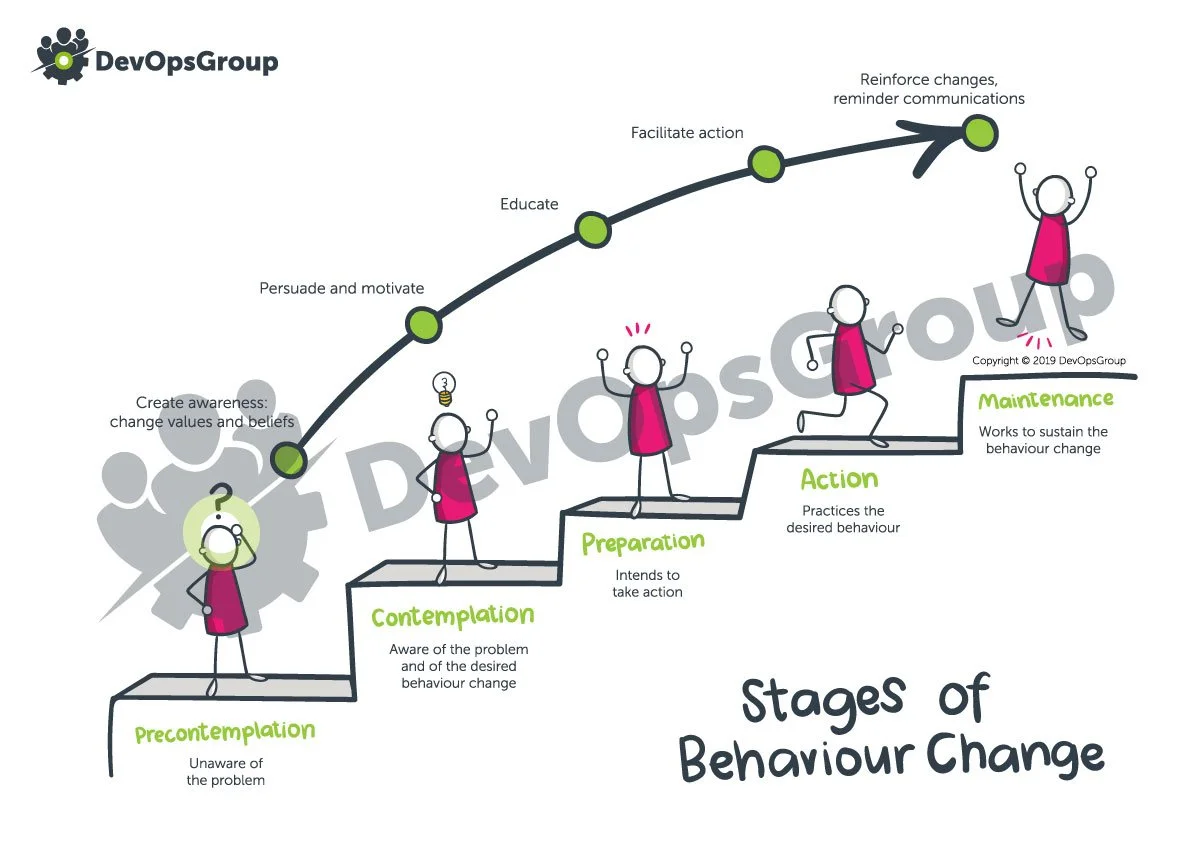
Organizational change has historically been described in terms of systems, strategy, and structure. However, in recent years there has been growing recognition that sustainable transformation depends on people — their behaviors, motivations, and internal models of work. Understanding behavioral change as a science rather than an art has become central to how modern companies pursue innovation, culture improvement, and performance optimization.
Why Behavior Drives Transformation
Companies often invest heavily in new technologies, reorganizations, or corporate plans only to see limited improvements. The breakdown occurs not at the strategy level, but at the behavioral execution layer. Employees must internalize new norms, habits, and decision-making patterns for transformation to become reality. This is ultimately a behavioral science challenge involving psychology, incentives, identity, and learning.
Effective behavioral change must address both intrinsic and extrinsic drivers. Intrinsic drivers include autonomy, mastery, purpose, and identity — factors that influence self-determined motivation. Extrinsic drivers involve reinforcement systems, accountability structures, policies, and rewards. Balancing the two prevents burnout and disengagement, while ensuring alignment between individual action and organizational goals.
The Role of Behavioral Friction
Behavioral friction refers to the invisible obstacles that make new behaviors difficult to perform. These show up as cognitive overload, unclear instructions, time scarcity, or conflicting incentives. Removing friction often produces greater results than increasing motivation. For example, simplifying workflows or information pathways can substantially increase adoption rates without additional training or coercion.
Behavioral design frameworks often map employee workflows similarly to user experience journeys. By reducing unnecessary steps, clarifying expectations, and standardizing pathways, organizations can boost compliance, productivity, and innovation while reducing error and fatigue.
The Psychology of Habit Formation
Habits are the foundation of behavioral change. They form through repetition in stable contexts and are strengthened by rewards. In organizations, habits often relate to communication, prioritization, risk tolerance, and collaboration. Leaders who understand habit loops can redesign routines and reduce cognitive effort required for new behaviors. Training programs that attempt to change behavior without modifying environment or reinforcement usually fail, because habits are context-dependent rather than knowledge-dependent.
Increasingly, organizations are also exploring complementary perspectives on human behavior that consider physiological and energetic feedback mechanisms. Approaches such as bioresonance — explored in more depth at Bio-Wellbeing (https://bio-wellbeing.co.uk) — highlight how internal states can influence behavioral patterns, resilience, and responsiveness to change initiatives.
The Cultural Layer of Change
Culture is best viewed as a shared bundle of behaviors that become normalized over time. Culture change is therefore behavior change at scale. Organizational culture shifts when enough individuals modify visible actions such as how they speak, collaborate, escalate issues, or make decisions. Storytelling, rituals, and leadership signals are highly influential because they convey what “good” looks like inside the group.
Behavioral Measurement & Feedback Systems
What cannot be measured cannot be optimized. Behavioral initiatives benefit from feedback loops that quantify progress and reinforce change. Digital tools, performance dashboards, and regular retrospectives create data transparency and accelerate adaptation. Without feedback, behavioral change becomes episodic rather than compounding.
Regular measurement also enables course correction. A change initiative may require new incentives, new communication approaches, or even a change in pace. Behavioral agility is now considered an organizational competency, particularly in markets where volatility is high.
Keyword Placement Paragraph
From a competitive perspective, many organizations adopt behavioral change initiatives to improve employee engagement strategies and reduce turnover. This illustrates how behavioral science has become a business lever rather than solely an HR function.
Case Studies & Real-World Insights
In the past decade, major corporations have integrated behavioral scientists, organizational psychologists, and habit-design specialists into strategy teams. Tech firms have led in this space due to their reliance on cognitive workflows and digital adoption, but financial services, healthcare, and professional services are rapidly following.
Recent reporting has highlighted how companies that actively build behavioral capability accelerate transformation outcomes faster than those that rely on command-and-control change management. The role of behavioral science has become particularly prominent in hybrid work models, where asynchronous environments require new collaboration patterns to remain productive.
The Future of Behavioral Change
The future will likely emphasize personalization at scale. Instead of prescribing uniform change initiatives, organizations will design adaptive behavioral systems that fit individual preferences, job roles, and motivational profiles. Artificial intelligence may support micro-nudging and real-time reinforcement to sustain behavioral shifts without excessive managerial oversight.
Change management as a static discipline is fading. Behavioral change as a science-driven, feedback-rich, and employee-centric practice is becoming the new paradigm.

